
An outline of their content and importance...
There are many paths claiming to lead to Self-realization, but one taught by Patanjali in his Yoga Sutras excels in the training of the mind. Step-by-step the mind is examined scientifically down to its subtlest detail until it reaches a point of understanding itself. This is accomplished through engaging gradual exercises which produce great powers of concentration, contemplation and meditation. The mind then, collected and focused to a degree hardly imaginable before, gathers all its inherent powers into one point and demonstrates mastery over the physical universe.
Additionally and in accord with the worlds principle spiritual teachings, Patanjali offers a training of the moral/ethical nature, as well, this so that powers attained through one-pointed focus of the mind are not misused at the expense of others. Ahimsa (non-injury) is the first principle in this training, and it’s an all-inclusive precept directed not only toward other sentient beings but also toward oneself.
The Essence of Patanjali’s Yoga Sutras (AKA; Raja Yoga)
In Sanskrit, Raja Yoga, literally means the kingly yoga, is the greatest contribution of Maharishi Patanjali. His descriptions of the levels of the mind often read like the most contemporary and enlightened schools of psychology. Just by reading the text the student will gain a certain clarity and objectivity in identifying the various processes of the mind.

Briefly, the four books (or chapters) of Patanjali’s Yoga Sutras encompass the following subjects:
Book 1: Samadhi-Pada (Concentration) - Through various concentration and meditation practices, one may disentangle the mind from its constant “chattering”, removing obstacles and providing solutions, and the means to stabilize the mind. This chapter describes the different stages (or levels) of spiritual experiences available to the mind, as it ascends toward the attainment of the highest level of such experiences.
The 51 Sutras of Book 1 have been divided into 9 sections:
1. What is yoga? (1.1-1.4)
2. Witnessing and “Un-coloring” thoughts (interfering mental impressions) (1.5-1.11)
3. Practice and non-attachment (1.12-1.16)
4. Types of concentration (1.17-1.18)
5. Efforts and commitment (1.19-1.22)
6. Direct route through AUM (1.23-1.29)
7. Obstacles and solutions (1.30-1.32)
8. Stabilizing and clearing the mind (1.33-1.39)
9. Results of stabilizing the mind (1.40-1.51)
Book 2: Sadhana-Pada (Practices) - Chapter 2 outlines specific tools of attention that are used to systematically cut away the obstacles of the inner mental shield, obstacles that are blocking the light of the Self within. This includes the first 5 of the 8 rungs of yoga, known as Ashtanga yoga. Through proper training of the body and moral nature, one gradually purifies the personality of its idiosyncrasies so that it can become a vehicle capable of carrying the consciousness to higher and higher levels of spiritual experience.
The 55 sutras of Book 2 have been divided into 9 sections:
1. Minimizing gross coloring (2.1-2.9)
2. Dealing with subtle thoughts (2.10-2.11)
3. Breaking the alliance of karma (2.12-2.25)
4. The 8 rungs and discrimination (2.26-2.29)
5. Yamas and Niyamas, rungs #1 and 2 of 8 (2.30-2.34)
6. Benefits from Yamas and Niyamas (2.35-2.45)
7. Asana, rung #3 of 8 (2.46-2.48)
8. Pranayama, rung #4 of 8 (2.49-2.53)
9. Pratyahara, rung #5 of 8 (2.54-2.55)
Book 3: Vibhuti-Pada (Progressing) - Chapter 3 starts by presenting the last 3 of the 8 rungs of yoga, which are concentration, meditation, and samadhi, collectively known as samyama. The rest of the chapter explains how samyama is used as the finer tool to remove the subtler veils of ignorance. This constitutes the highest focusing power of the mind and the extraordinary supernormal powers which can be attained.
The 56 sutras of Book 3 have been divided into 9 sections:
1. Dharana, dhyana, and samadhi, rungs #6-8 of 8 (3.1-3.3)
2. Samyama is the finer tool (3.4-3.6)
3. Internal is seen to be external (3.7-3.8)
4. Witnessing subtle transitions (3.9-3.16)
5. Experiences from samyama (3.17-3.37)
6. What to do with experiences (3.38)
7. More from samyama (3.39-3.49)
8. Renunciation and liberation (3.50-3.52)
9. Higher discrimination (3.53-3.56)
Book 4: Kaivalya-Pada (Final Liberation) - Chapter 4 explains how the mind is constructed and veils the inner light of the Self. It describes how the yogi deals with the natural breaches in enlightenment, and how the primal building blocks of the mind resolve back into their cause, allowing final liberation. The ultimate goal of this Sutra is to experience the sublime state of complete freedom from the effects of the physical plane, while still living in the physical body.
The 34 sutras of Book 4 have been divided into 12 sections:
1. Means of attaining experience (4.1-4.3)
2. Emergence and mastery of mind (4.4-4.6)
3. Actions and karma (4.7-4.8)
4. Subconscious impressions (4.9-4.12)
5. Objects and the three gunas (4.13-4.14)
6. Mind perceiving objects (4.15-4.17)
7. Illumination of the mind (4.18-4.21)
8. Buddhi and liberation (4.22-4.26)
9. Breaches in enlightenment (4.27-4.28)
10. Perpetual enlightenment (4.29-4.30)
11. Knowables become few (4.31)
12. Gunas after liberation (4.32-4.34)
There are many paths or methods of attaining Yoga (Union with the Self). Five of the principle paths are:
1. Karma Yoga - The technique of remaining in touch with the spiritual worlds while engaged in the actions of daily life.
2. Jnana Yoga - Seeing and experiencing the light of the Spirit everywhere.
3. Bhakti Yoga - Devoted attention, service and love toward the One Life present everywhere.
4. Raja Yoga - Training of the mind to return to the pure and complete consciousness behind the intellectual and intuitive faculties.
5. Hatha Yoga - Training of the body and breathing processes, to achieve consciouness of the presence of Spirit in the cells of the physical body.

*Each individual Yoga student may be inclined by their temperament or abilities to emphasize one of these paths over the others, but they intermingle and overlap and, ideally, should all be present to some degree as limbs of a complete Yoga practice.
There are many paths claiming to lead to Self-realization, but one taught by Patanjali in his Yoga Sutras excels in the training of the mind. Step-by-step the mind is examined scientifically down to its subtlest detail until it reaches a point of understanding itself. This is accomplished through engaging gradual exercises which produce great powers of concentration, contemplation and meditation. The mind then, collected and focused to a degree hardly imaginable before, gathers all its inherent powers into one point and demonstrates mastery over the physical universe.
Additionally and in accord with the worlds principle spiritual teachings, Patanjali offers a training of the moral/ethical nature, as well, this so that powers attained through one-pointed focus of the mind are not misused at the expense of others. Ahimsa (non-injury) is the first principle in this training, and it’s an all-inclusive precept directed not only toward other sentient beings but also toward oneself.
The Essence of Patanjali’s Yoga Sutras (AKA; Raja Yoga)
In Sanskrit, Raja Yoga, literally means the kingly yoga, is the greatest contribution of Maharishi Patanjali. His descriptions of the levels of the mind often read like the most contemporary and enlightened schools of psychology. Just by reading the text the student will gain a certain clarity and objectivity in identifying the various processes of the mind.
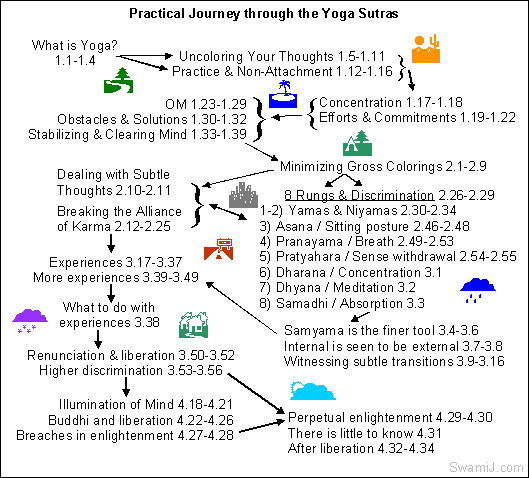
Briefly, the four books (or chapters) of Patanjali’s Yoga Sutras encompass the following subjects:
Book 1: Samadhi-Pada (Concentration) - Through various concentration and meditation practices, one may disentangle the mind from its constant “chattering”, removing obstacles and providing solutions, and the means to stabilize the mind. This chapter describes the different stages (or levels) of spiritual experiences available to the mind, as it ascends toward the attainment of the highest level of such experiences.
The 51 Sutras of Book 1 have been divided into 9 sections:
1. What is yoga? (1.1-1.4)
2. Witnessing and “Un-coloring” thoughts (interfering mental impressions) (1.5-1.11)
3. Practice and non-attachment (1.12-1.16)
4. Types of concentration (1.17-1.18)
5. Efforts and commitment (1.19-1.22)
6. Direct route through AUM (1.23-1.29)
7. Obstacles and solutions (1.30-1.32)
8. Stabilizing and clearing the mind (1.33-1.39)
9. Results of stabilizing the mind (1.40-1.51)
Book 2: Sadhana-Pada (Practices) - Chapter 2 outlines specific tools of attention that are used to systematically cut away the obstacles of the inner mental shield, obstacles that are blocking the light of the Self within. This includes the first 5 of the 8 rungs of yoga, known as Ashtanga yoga. Through proper training of the body and moral nature, one gradually purifies the personality of its idiosyncrasies so that it can become a vehicle capable of carrying the consciousness to higher and higher levels of spiritual experience.
The 55 sutras of Book 2 have been divided into 9 sections:
1. Minimizing gross coloring (2.1-2.9)
2. Dealing with subtle thoughts (2.10-2.11)
3. Breaking the alliance of karma (2.12-2.25)
4. The 8 rungs and discrimination (2.26-2.29)
5. Yamas and Niyamas, rungs #1 and 2 of 8 (2.30-2.34)
6. Benefits from Yamas and Niyamas (2.35-2.45)
7. Asana, rung #3 of 8 (2.46-2.48)
8. Pranayama, rung #4 of 8 (2.49-2.53)
9. Pratyahara, rung #5 of 8 (2.54-2.55)
Book 3: Vibhuti-Pada (Progressing) - Chapter 3 starts by presenting the last 3 of the 8 rungs of yoga, which are concentration, meditation, and samadhi, collectively known as samyama. The rest of the chapter explains how samyama is used as the finer tool to remove the subtler veils of ignorance. This constitutes the highest focusing power of the mind and the extraordinary supernormal powers which can be attained.
The 56 sutras of Book 3 have been divided into 9 sections:
1. Dharana, dhyana, and samadhi, rungs #6-8 of 8 (3.1-3.3)
2. Samyama is the finer tool (3.4-3.6)
3. Internal is seen to be external (3.7-3.8)
4. Witnessing subtle transitions (3.9-3.16)
5. Experiences from samyama (3.17-3.37)
6. What to do with experiences (3.38)
7. More from samyama (3.39-3.49)
8. Renunciation and liberation (3.50-3.52)
9. Higher discrimination (3.53-3.56)
Book 4: Kaivalya-Pada (Final Liberation) - Chapter 4 explains how the mind is constructed and veils the inner light of the Self. It describes how the yogi deals with the natural breaches in enlightenment, and how the primal building blocks of the mind resolve back into their cause, allowing final liberation. The ultimate goal of this Sutra is to experience the sublime state of complete freedom from the effects of the physical plane, while still living in the physical body.
The 34 sutras of Book 4 have been divided into 12 sections:
1. Means of attaining experience (4.1-4.3)
2. Emergence and mastery of mind (4.4-4.6)
3. Actions and karma (4.7-4.8)
4. Subconscious impressions (4.9-4.12)
5. Objects and the three gunas (4.13-4.14)
6. Mind perceiving objects (4.15-4.17)
7. Illumination of the mind (4.18-4.21)
8. Buddhi and liberation (4.22-4.26)
9. Breaches in enlightenment (4.27-4.28)
10. Perpetual enlightenment (4.29-4.30)
11. Knowables become few (4.31)
12. Gunas after liberation (4.32-4.34)
There are many paths or methods of attaining Yoga (Union with the Self). Five of the principle paths are:
1. Karma Yoga - The technique of remaining in touch with the spiritual worlds while engaged in the actions of daily life.
2. Jnana Yoga - Seeing and experiencing the light of the Spirit everywhere.
3. Bhakti Yoga - Devoted attention, service and love toward the One Life present everywhere.
4. Raja Yoga - Training of the mind to return to the pure and complete consciousness behind the intellectual and intuitive faculties.
5. Hatha Yoga - Training of the body and breathing processes, to achieve consciouness of the presence of Spirit in the cells of the physical body.
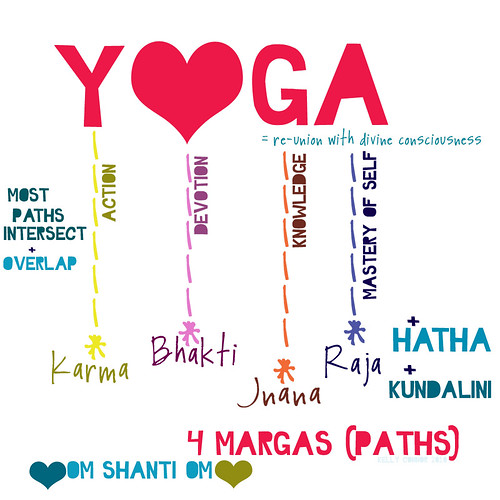
*Each individual Yoga student may be inclined by their temperament or abilities to emphasize one of these paths over the others, but they intermingle and overlap and, ideally, should all be present to some degree as limbs of a complete Yoga practice.


