Yoga Master Fred Busch shares his thoughts and wisdom on Health, Yoga, the Environment and Current Events. Fred is the founder of Miami Yoga and Brickell Hot Yoga in Florida, USA. FRED Busch is director of HOT POWER Yoga Teacher Training in studios in Miami, New York, Denver, London, Malta, Moscow, Lima, and Bogota. Power Yoga Teacher Trainings and retreats are also offered at FRED Busch's Salamadhi Ranch in Colorado's Rocky Mountains. www.fredbusch.com www.miamiyoga.com www.salamadhi.com
Showing posts with label Meditation. Show all posts
Friday, April 24, 2015
Saturday, July 5, 2014
Ujjayi Breathing a Pranayama Practice
A yoga teacher training tutorial on Ujjayi breathing offered by Fred Busch Yoga
Ujayi Breathing is the key to the Fred Busch Hot Power Yoga system as it provides an anchor for attention during the practice so that the mind does not wander.
Yoga Teacher Training Tutorial: Ujjayi Breathing
Ujayi Breathing is the key to the Fred Busch Hot Power Yoga system as it provides an anchor for attention during the practice so that the mind does not wander.
Yoga Teacher Training Tutorial: Ujjayi Breathing
Tuesday, March 26, 2013
Why Study Patanjali’s Yoga Sutras?
An outline of their content and importance...
There are many paths claiming to lead to Self-realization, but one taught by Patanjali in his Yoga Sutras excels in the training of the mind. Step-by-step the mind is examined scientifically down to its subtlest detail until it reaches a point of understanding itself. This is accomplished through engaging gradual exercises which produce great powers of concentration, contemplation and meditation. The mind then, collected and focused to a degree hardly imaginable before, gathers all its inherent powers into one point and demonstrates mastery over the physical universe.
Additionally and in accord with the worlds principle spiritual teachings, Patanjali offers a training of the moral/ethical nature, as well, this so that powers attained through one-pointed focus of the mind are not misused at the expense of others. Ahimsa (non-injury) is the first principle in this training, and it’s an all-inclusive precept directed not only toward other sentient beings but also toward oneself.
The Essence of Patanjali’s Yoga Sutras (AKA; Raja Yoga)
In Sanskrit, Raja Yoga, literally means the kingly yoga, is the greatest contribution of Maharishi Patanjali. His descriptions of the levels of the mind often read like the most contemporary and enlightened schools of psychology. Just by reading the text the student will gain a certain clarity and objectivity in identifying the various processes of the mind.
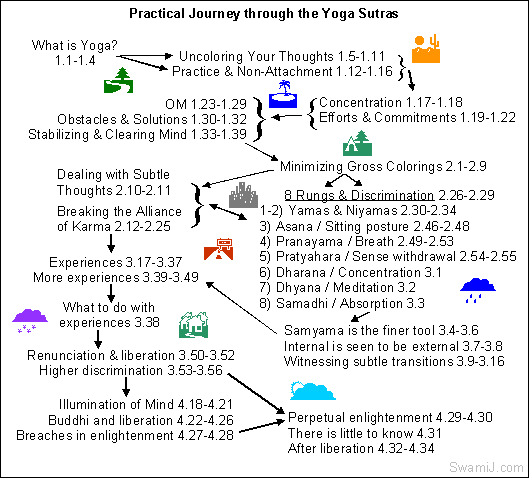
Briefly, the four books (or chapters) of Patanjali’s Yoga Sutras encompass the following subjects:
Book 1: Samadhi-Pada (Concentration) - Through various concentration and meditation practices, one may disentangle the mind from its constant “chattering”, removing obstacles and providing solutions, and the means to stabilize the mind. This chapter describes the different stages (or levels) of spiritual experiences available to the mind, as it ascends toward the attainment of the highest level of such experiences.
The 51 Sutras of Book 1 have been divided into 9 sections:
1. What is yoga? (1.1-1.4)
2. Witnessing and “Un-coloring” thoughts (interfering mental impressions) (1.5-1.11)
3. Practice and non-attachment (1.12-1.16)
4. Types of concentration (1.17-1.18)
5. Efforts and commitment (1.19-1.22)
6. Direct route through AUM (1.23-1.29)
7. Obstacles and solutions (1.30-1.32)
8. Stabilizing and clearing the mind (1.33-1.39)
9. Results of stabilizing the mind (1.40-1.51)
Book 2: Sadhana-Pada (Practices) - Chapter 2 outlines specific tools of attention that are used to systematically cut away the obstacles of the inner mental shield, obstacles that are blocking the light of the Self within. This includes the first 5 of the 8 rungs of yoga, known as Ashtanga yoga. Through proper training of the body and moral nature, one gradually purifies the personality of its idiosyncrasies so that it can become a vehicle capable of carrying the consciousness to higher and higher levels of spiritual experience.
The 55 sutras of Book 2 have been divided into 9 sections:
1. Minimizing gross coloring (2.1-2.9)
2. Dealing with subtle thoughts (2.10-2.11)
3. Breaking the alliance of karma (2.12-2.25)
4. The 8 rungs and discrimination (2.26-2.29)
5. Yamas and Niyamas, rungs #1 and 2 of 8 (2.30-2.34)
6. Benefits from Yamas and Niyamas (2.35-2.45)
7. Asana, rung #3 of 8 (2.46-2.48)
8. Pranayama, rung #4 of 8 (2.49-2.53)
9. Pratyahara, rung #5 of 8 (2.54-2.55)
Book 3: Vibhuti-Pada (Progressing) - Chapter 3 starts by presenting the last 3 of the 8 rungs of yoga, which are concentration, meditation, and samadhi, collectively known as samyama. The rest of the chapter explains how samyama is used as the finer tool to remove the subtler veils of ignorance. This constitutes the highest focusing power of the mind and the extraordinary supernormal powers which can be attained.
The 56 sutras of Book 3 have been divided into 9 sections:
1. Dharana, dhyana, and samadhi, rungs #6-8 of 8 (3.1-3.3)
2. Samyama is the finer tool (3.4-3.6)
3. Internal is seen to be external (3.7-3.8)
4. Witnessing subtle transitions (3.9-3.16)
5. Experiences from samyama (3.17-3.37)
6. What to do with experiences (3.38)
7. More from samyama (3.39-3.49)
8. Renunciation and liberation (3.50-3.52)
9. Higher discrimination (3.53-3.56)
Book 4: Kaivalya-Pada (Final Liberation) - Chapter 4 explains how the mind is constructed and veils the inner light of the Self. It describes how the yogi deals with the natural breaches in enlightenment, and how the primal building blocks of the mind resolve back into their cause, allowing final liberation. The ultimate goal of this Sutra is to experience the sublime state of complete freedom from the effects of the physical plane, while still living in the physical body.
The 34 sutras of Book 4 have been divided into 12 sections:
1. Means of attaining experience (4.1-4.3)
2. Emergence and mastery of mind (4.4-4.6)
3. Actions and karma (4.7-4.8)
4. Subconscious impressions (4.9-4.12)
5. Objects and the three gunas (4.13-4.14)
6. Mind perceiving objects (4.15-4.17)
7. Illumination of the mind (4.18-4.21)
8. Buddhi and liberation (4.22-4.26)
9. Breaches in enlightenment (4.27-4.28)
10. Perpetual enlightenment (4.29-4.30)
11. Knowables become few (4.31)
12. Gunas after liberation (4.32-4.34)
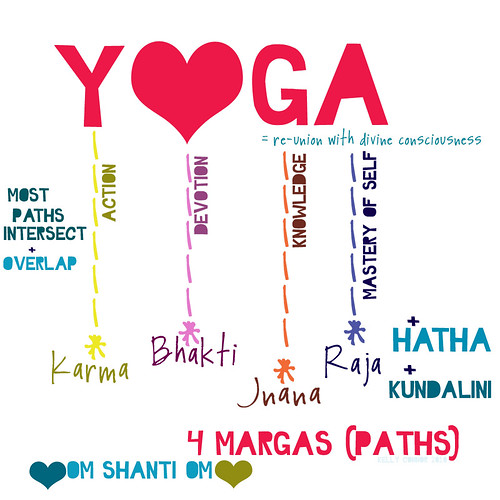
There are many paths or methods of attaining Yoga (Union with the Self). Five of the principle paths are:
1. Karma Yoga - The technique of remaining in touch with the spiritual worlds while engaged in the actions of daily life.
2. Jnana Yoga - Seeing and experiencing the light of the Spirit everywhere.
3. Bhakti Yoga - Devoted attention, service and love toward the One Life present everywhere.
4. Raja Yoga - Training of the mind to return to the pure and complete consciousness behind the intellectual and intuitive faculties.
5. Hatha Yoga - Training of the body and breathing processes, to achieve consciouness of the presence of Spirit in the cells of the physical body.
*Each individual Yoga student may be inclined by their temperament or abilities to emphasize one of these paths over the others, but they intermingle and overlap and, ideally, should all be present to some degree as limbs of a complete Yoga practice.
There are many paths claiming to lead to Self-realization, but one taught by Patanjali in his Yoga Sutras excels in the training of the mind. Step-by-step the mind is examined scientifically down to its subtlest detail until it reaches a point of understanding itself. This is accomplished through engaging gradual exercises which produce great powers of concentration, contemplation and meditation. The mind then, collected and focused to a degree hardly imaginable before, gathers all its inherent powers into one point and demonstrates mastery over the physical universe.
Additionally and in accord with the worlds principle spiritual teachings, Patanjali offers a training of the moral/ethical nature, as well, this so that powers attained through one-pointed focus of the mind are not misused at the expense of others. Ahimsa (non-injury) is the first principle in this training, and it’s an all-inclusive precept directed not only toward other sentient beings but also toward oneself.
The Essence of Patanjali’s Yoga Sutras (AKA; Raja Yoga)
In Sanskrit, Raja Yoga, literally means the kingly yoga, is the greatest contribution of Maharishi Patanjali. His descriptions of the levels of the mind often read like the most contemporary and enlightened schools of psychology. Just by reading the text the student will gain a certain clarity and objectivity in identifying the various processes of the mind.
Briefly, the four books (or chapters) of Patanjali’s Yoga Sutras encompass the following subjects:
Book 1: Samadhi-Pada (Concentration) - Through various concentration and meditation practices, one may disentangle the mind from its constant “chattering”, removing obstacles and providing solutions, and the means to stabilize the mind. This chapter describes the different stages (or levels) of spiritual experiences available to the mind, as it ascends toward the attainment of the highest level of such experiences.
The 51 Sutras of Book 1 have been divided into 9 sections:
1. What is yoga? (1.1-1.4)
2. Witnessing and “Un-coloring” thoughts (interfering mental impressions) (1.5-1.11)
3. Practice and non-attachment (1.12-1.16)
4. Types of concentration (1.17-1.18)
5. Efforts and commitment (1.19-1.22)
6. Direct route through AUM (1.23-1.29)
7. Obstacles and solutions (1.30-1.32)
8. Stabilizing and clearing the mind (1.33-1.39)
9. Results of stabilizing the mind (1.40-1.51)
Book 2: Sadhana-Pada (Practices) - Chapter 2 outlines specific tools of attention that are used to systematically cut away the obstacles of the inner mental shield, obstacles that are blocking the light of the Self within. This includes the first 5 of the 8 rungs of yoga, known as Ashtanga yoga. Through proper training of the body and moral nature, one gradually purifies the personality of its idiosyncrasies so that it can become a vehicle capable of carrying the consciousness to higher and higher levels of spiritual experience.
The 55 sutras of Book 2 have been divided into 9 sections:
1. Minimizing gross coloring (2.1-2.9)
2. Dealing with subtle thoughts (2.10-2.11)
3. Breaking the alliance of karma (2.12-2.25)
4. The 8 rungs and discrimination (2.26-2.29)
5. Yamas and Niyamas, rungs #1 and 2 of 8 (2.30-2.34)
6. Benefits from Yamas and Niyamas (2.35-2.45)
7. Asana, rung #3 of 8 (2.46-2.48)
8. Pranayama, rung #4 of 8 (2.49-2.53)
9. Pratyahara, rung #5 of 8 (2.54-2.55)
Book 3: Vibhuti-Pada (Progressing) - Chapter 3 starts by presenting the last 3 of the 8 rungs of yoga, which are concentration, meditation, and samadhi, collectively known as samyama. The rest of the chapter explains how samyama is used as the finer tool to remove the subtler veils of ignorance. This constitutes the highest focusing power of the mind and the extraordinary supernormal powers which can be attained.
The 56 sutras of Book 3 have been divided into 9 sections:
1. Dharana, dhyana, and samadhi, rungs #6-8 of 8 (3.1-3.3)
2. Samyama is the finer tool (3.4-3.6)
3. Internal is seen to be external (3.7-3.8)
4. Witnessing subtle transitions (3.9-3.16)
5. Experiences from samyama (3.17-3.37)
6. What to do with experiences (3.38)
7. More from samyama (3.39-3.49)
8. Renunciation and liberation (3.50-3.52)
9. Higher discrimination (3.53-3.56)
Book 4: Kaivalya-Pada (Final Liberation) - Chapter 4 explains how the mind is constructed and veils the inner light of the Self. It describes how the yogi deals with the natural breaches in enlightenment, and how the primal building blocks of the mind resolve back into their cause, allowing final liberation. The ultimate goal of this Sutra is to experience the sublime state of complete freedom from the effects of the physical plane, while still living in the physical body.
The 34 sutras of Book 4 have been divided into 12 sections:
1. Means of attaining experience (4.1-4.3)
2. Emergence and mastery of mind (4.4-4.6)
3. Actions and karma (4.7-4.8)
4. Subconscious impressions (4.9-4.12)
5. Objects and the three gunas (4.13-4.14)
6. Mind perceiving objects (4.15-4.17)
7. Illumination of the mind (4.18-4.21)
8. Buddhi and liberation (4.22-4.26)
9. Breaches in enlightenment (4.27-4.28)
10. Perpetual enlightenment (4.29-4.30)
11. Knowables become few (4.31)
12. Gunas after liberation (4.32-4.34)
There are many paths or methods of attaining Yoga (Union with the Self). Five of the principle paths are:
1. Karma Yoga - The technique of remaining in touch with the spiritual worlds while engaged in the actions of daily life.
2. Jnana Yoga - Seeing and experiencing the light of the Spirit everywhere.
3. Bhakti Yoga - Devoted attention, service and love toward the One Life present everywhere.
4. Raja Yoga - Training of the mind to return to the pure and complete consciousness behind the intellectual and intuitive faculties.
5. Hatha Yoga - Training of the body and breathing processes, to achieve consciouness of the presence of Spirit in the cells of the physical body.
*Each individual Yoga student may be inclined by their temperament or abilities to emphasize one of these paths over the others, but they intermingle and overlap and, ideally, should all be present to some degree as limbs of a complete Yoga practice.
Sunday, January 13, 2013
Did you know? - Attachment and Aversion
Did you know? Did you know that attachment and aversion are both obstacles?
Yes indeed it is not only the idea of being attached to things that is not encouraged on the spiritual path... also and equally important is the idea of non-aversion...not hating things, not having a negative energy field towards things.
Known as Raga (attachment) and Dvesha or Dvesa (aversion) in Sanskrit, both are an obstacle to the experience of freedom and power found in the divine present moment. They are emotional responses that negatively affect our ability to see the world around us clearly and without projection. This negative state is called avidya (non-seeing). In this state of non-seeing, pain is mistaken for pleasure, impermanence for permanence, and the profane for the sacred.
Attachments arise from imprinted memories of previous experiences of pleasure and happiness. Aversions originate from memories of previous experiences of pain and suffering. Over time, as we accumulate a long list of these likes and dislikes, our sense of self-identity is formed, and we begin defining ourselves as a collection of these ingrained emotional responses.
We tend to seek the pleasurable (perhaps even sub-consciously) and we slowly become attached, even to the point of addiction. We avoid the situations and things that remind us of our previous painful experiences and feel the need to protect ourselves from them. Aversion in the forms of fear and hatred are the results.
If we practice a form of meditative self-inquiry, and begin observing ourselves honestly and then reflecting on what we find, we can gradually increase our ability to understand ourselves. We start by becoming aware of our powerful likes and dislikes and how much we are controlled by them. Next, we become aware of the sources and triggers behind those tendencies. Over time, we are able to put a stop to the behaviors that seem to empower these obstacles, and as a result we liberate ourselves, opening ourselves up to new ways of observing and being in the world. Subsequently, we end the impulse to form our self-identity so heavily based on our emotional past. Additionally we are able to build a sense of self that radiates a deeper and more universal reflection of our indwelling spirit.
Yes indeed it is not only the idea of being attached to things that is not encouraged on the spiritual path... also and equally important is the idea of non-aversion...not hating things, not having a negative energy field towards things.
Known as Raga (attachment) and Dvesha or Dvesa (aversion) in Sanskrit, both are an obstacle to the experience of freedom and power found in the divine present moment. They are emotional responses that negatively affect our ability to see the world around us clearly and without projection. This negative state is called avidya (non-seeing). In this state of non-seeing, pain is mistaken for pleasure, impermanence for permanence, and the profane for the sacred.
| Both Attachment ans Aversion follow this pattern |
We tend to seek the pleasurable (perhaps even sub-consciously) and we slowly become attached, even to the point of addiction. We avoid the situations and things that remind us of our previous painful experiences and feel the need to protect ourselves from them. Aversion in the forms of fear and hatred are the results.
If we practice a form of meditative self-inquiry, and begin observing ourselves honestly and then reflecting on what we find, we can gradually increase our ability to understand ourselves. We start by becoming aware of our powerful likes and dislikes and how much we are controlled by them. Next, we become aware of the sources and triggers behind those tendencies. Over time, we are able to put a stop to the behaviors that seem to empower these obstacles, and as a result we liberate ourselves, opening ourselves up to new ways of observing and being in the world. Subsequently, we end the impulse to form our self-identity so heavily based on our emotional past. Additionally we are able to build a sense of self that radiates a deeper and more universal reflection of our indwelling spirit.
Thursday, September 20, 2012
Did you know? That there are many ways of meditating and meditation is not what you think. (VIDEO)
Did you know? Did you know that there are many ways of meditating? Seated still mind meditation is one type, but only one type.
| Formal "seated" meditation in a full lotus position |
Meditation is any practice that allows us to transcend our thinking minds and the suffering that they produce. Swimming, running, chanting are all ways of experiencing the deep peace found beyond the mind. It is also interesting to note that the Tibetan Buddhist Meditation tradition does not have seated still mind meditation as one of their practices whatsoever. The meditation practice given by the Buddha to all his disciples is called Vipassana and is a practice of keeping attention on the relaxed breath as the focus of meditation.
Vipassana means 'to come and see'. To be more precise – ‘to come inward and see’, and thus is often referred to as ‘insight meditation’. The practice of Vipassana meditation as instructed by the Buddha is ‘To watch your breath with awareness’. That's all! It’s just that simple, to remain watchful of your breath as it comes and goes. That is Vipassana. It’s the easiest meditation technique of all time. It’s the kind of friendly meditation which can be practiced by anybody, anywhere and at any time.
It has been said that the most fruitful meditation becomes ‘seamless’ and you’ll know you’ve attained real success when you can be aware of your breath while doing all kinds of daily activities like reading, playing, driving a car, even running errands or doing simple domestic tasks. This stage will come after continuing the regular practice of bringing your attention back to the breath for a considerable amount of time. At that point you will become aware of two basic aspects of your existence, ‘doing’ and ‘being’. You will notice that you’re doing everything, fully involved in your tasks, yet inside you’ll have established a center of awareness that is completely undisturbed by outer circumstances. That will be the true state of a meditator.

Of related interest: Video - Meditation after Yoga Class - Fred Busch Power Yoga
Tuesday, August 7, 2012
Put Some “Gusto” in Your Life with a Yoga Retreat!
| Yoga Instructor Rae Indigo - Colorado Retreat |
Have you ever dreamed of stepping out of your daily routine and retreating to a place where you’re offered delicious, healthy food and someone leads you in daily yoga and meditation practice? Where you’re in the company of other like-minded/like-hearted seekers of truth, love and beauty?
Have you ever wondered what might happen to you and to your life if you would just make the time to retreat to a place like that? Well, get out of your daily routine for a while and give yourself the chance to have a life changing experience. Once you’re on a yoga retreat (or yoga holiday, as they’re sometimes called) all your regular daily obstacles will be gone and your day to day hassles will be put on hold, while you’re hooked up to a program that offers solutions for when you go back. You’ll return rejuvenated and recharged and with a whole new attitude, plus you’ll be feeling energy you haven’t felt since you were a kid.
There are many reasons people go on a yoga retreat:
· Deepening an existing practice
· Restarting a practice that was dropped
· Testing the waters (if you’re new to Yoga)
· Finding a new direction in life
· Meeting new, exciting people
What kind of people go on Yoga retreats?:
· Some are young; others are elderly (and all in between).
· Some are loose and flexible, while others are a stiff as a board.
· Some may be exhausted or at a crossroads in their life.
· Some simply want a chance to get away from it all.
· Others want to take care of just themselves for a change.
There are times on a Yoga retreat when adventurous activities like hiking through beautiful landscapes are offered and other times when silence is observed while doing cooperative communal service. There may be new dietary experiences to taste and enjoy, learning to practice “Ahimsa” (non-injury to others) while enjoying plant based foods - both raw and cooked. There may be a time for cleansing and giving the body a break from un-healthy habits.
| Fred Busch - Director of Teacher Training |
On some retreats you’ll be surrounded by beautiful settings, while on others you may focus on sensual pleasures like massage, energetic healing or bodywork. A Yoga retreat may involve early morning meditation to stop the constant chatter of the mind. Also, there’s Vipassana (insight meditation) for those interested in self-reflection or looking for a more spiritual experience. There may be instruction which will help you learn Pranayama and other advanced breathing methods.
Stress is known to cause an emotional imbalance in someone who would normally be a level-headed person. Dealing on a daily basis with uptight and offensive people, handling unwanted responsibilities, the anxiety and road rage experienced while driving are just a few of the situations that wear us down. The emotional benefits of a Yoga retreat are huge because they offer a break from all this tension and distress! Just imagine the feeling of peace and being reconnected to the earth and all things natural, while harmonizing your mind, body and emotions through yoga asana and breathing.
It has been proven that stress is a contributing factor in 70% of the world diseases as reported by the World Health Organization (WHO). Many doctors are now realizing the benefits of yoga and by attending a yoga retreat; techniques will be taught which will lessen the likelihood of any type of stress related illness. You’ll be deepening the "intelligence" of your body, teaching it to respond in new ways to stressful situations.
Tip: Knowing exactly what kind of experience you’re looking for before signing up will help ensure you pick the retreat perfect for your needs. Selecting retreat with a time frame suited to your schedule is also important; whether it’s a day retreat, a few days, a week, or even longer. And, perhaps most importantly, it is always recommended that the retreat you select is lead by certified yoga instructors who are prepared to work with you at your skill level. Spending intimate time with an experienced yoga teacher is one of the most potent opportunities for change available today; being a mixture of instruction and inspiration, it will guide you toward being a more authentic and powerful human being.
In conclusion: Yoga retreats are the latest trend in yoga where you will be able to gain many profound benefits beyond those found when participating in a few hours of yoga sessions or classes. Those who attend such retreats and are guided by a yoga master, report experiencing a silent, inward revolution; one that produces a conscious growth and outward “evolution” of their body and mind. Contrary to the general belief that yoga is limited to an individualistic practice, a yoga retreat allows you the opportunity to explore the social aspect of yoga. Plus, the closeness to nature and having the time and opportunity to re-examine your motivations, goals, and beliefs helps you to become re-united with yourself and the awesome person you really are, both when you’re alone and in the company of others.
October 4th-7th: Fred Busch and Rae Indigo – Hot Yoga
October 11th-14th: Victoria Brunacci
October 18th-21h: Pablo Lucero
November 8th-11th: Claudia Bustillos
Click on Salamadhi Ranch Mountain Retreat Center for more.
October 11th-14th: Victoria Brunacci
October 18th-21h: Pablo Lucero
November 8th-11th: Claudia Bustillos
Click on Salamadhi Ranch Mountain Retreat Center for more.
Monday, January 11, 2010
Lose 10 Pounds and Add Ten Years to your Life!
“Lose 10 Pounds and Add Ten Years to your Life!” That was the quote i heard on the radio advertisement as i drove home recently. And i started thinking how fascinating it was that it was legal to promote something in that way... with statements that were so unverifiable. And I then i thought a bit harder and figured that this one of the most brilliant campaigns i had ever heard. Those two benefits combined together! Lose weight and extend your life by 10 years... it is ideal and what everyone wants!
And then of course i realized that this is exactly what we deliver in our Yoga and Detox programming. Lose 10 Pounds and add 10 years to your life... that is exactly what we are doing. I know that it is impossible to quantify this kind of thing but i just found it ironic that i took offense to some little pill claiming such outlandish benefits... then laughed to myself as i realized that the Daily Yoga Practice, the Intelligent Eating, and the Meditation and Self Realization components to Fred Busch Power Yoga and Detox do just that. Lose weight, get healthier, get stronger, feel true wellbeing, and add years to your life with the Fred Busch Teacher Training, Detox Program, or Yoga classes at of the Yogashala’s in Miami or abroad.
Lose weight in Miami with Miami Yogashala Detox Program which runs each month. Fred Busch guides through 5 Days of Yoga, Meditation, Healing and Nourishing Smoothies, and special secret factors for success on the path to long term health and wellbeing.
Individual Detox Programs can be created upon request. Call 305 606 2169.
For more information regarding Teacher Trainings and 5-day Detox programs, you may email fred busch at fred@miamiyoga.com. He also teaches about regarding Vegetarian Food, Vegan Food, Raw Food, Meditation, or Power Yoga. You may visit his websites by clicking the following links:
Miami Yoga Teacher Training
Yoga Teacher Training London
Detox Weight Loss Program
Miami Beach Power Yoga
Fred Busch
Namaste
And then of course i realized that this is exactly what we deliver in our Yoga and Detox programming. Lose 10 Pounds and add 10 years to your life... that is exactly what we are doing. I know that it is impossible to quantify this kind of thing but i just found it ironic that i took offense to some little pill claiming such outlandish benefits... then laughed to myself as i realized that the Daily Yoga Practice, the Intelligent Eating, and the Meditation and Self Realization components to Fred Busch Power Yoga and Detox do just that. Lose weight, get healthier, get stronger, feel true wellbeing, and add years to your life with the Fred Busch Teacher Training, Detox Program, or Yoga classes at of the Yogashala’s in Miami or abroad.
Lose weight in Miami with Miami Yogashala Detox Program which runs each month. Fred Busch guides through 5 Days of Yoga, Meditation, Healing and Nourishing Smoothies, and special secret factors for success on the path to long term health and wellbeing.
Individual Detox Programs can be created upon request. Call 305 606 2169.
For more information regarding Teacher Trainings and 5-day Detox programs, you may email fred busch at fred@miamiyoga.com. He also teaches about regarding Vegetarian Food, Vegan Food, Raw Food, Meditation, or Power Yoga. You may visit his websites by clicking the following links:
Miami Yoga Teacher Training
Yoga Teacher Training London
Detox Weight Loss Program
Miami Beach Power Yoga
Fred Busch
Namaste
Tuesday, November 3, 2009
Teaching Meditation
If you’re going to teach, with a little bit of attention, you more than you, employ it to the degree you want, you had employ immediately. Being in your presence needs to be relaxing, that will have to be transmitted at all times. In every word that you say, in every sentence that you speak you have to visualize centeredness; you have to exist from there. You have to keep it that way. You have to not make it more than that it is. First things first, you do not turn into something that it’s not. That people are spiritual by their very nature, it’s a done deal. They are human beings so you’re already there. All you have to do is let them see for themselves what they already are so there’s nothing has to be created, it’s the first thing to be understand. It won’t be like, “Oh, I got to create this sentences so that I can make you understand”, no. The whole point of this is that there’s no understanding involved. I can never convince you intellectually anything spiritually because it doesn’t operate on that level. Truth is not always operating on the level of intellectualization. First things first, relax. Spiritual part it needs to be easy going. Now, how do you do it? You realize that the spiritual part is already what you’re talking about with the breath. By telling someone to breathe perfectly or to breathe with an evenness on their breath, you’re giving them the opportunity to balance their mind and to still their mind, then the spiritual part, brushes in like a wave - it just emerges. Because all you got to do is say feel the stillness in your mind and feel how good that feels. You want them to experience that stuff for themselves but don’t make it more than that it is. As far as spiritual things are concern, I’ll give you some hints. Feel gratitude, you could say that a hundred times. And I want you to mean it, mean it, MEAN IT. When you say feel gratitude, you’re feeling it and intensely. And almost so intensely that you almost can’t even talk, that kind of gratitude. Like I can’t almost-- couldn’t start crying, because I have seen the gifts that I have been given and how incredible this is and how mystical, you have to begin to connect to that gratitude for yourself. The part of teacher sharing for you, cultivate this because it’s blissful. And again that’s the spiritual part. The gratitude is the spiritual part. You don’t have to say believe in God all you have to do is say feel gratitude wherever you want, feel it to wherever you want. Just feel it because it’s transformational. But don’t take my word for it. Always add things like that “don’t take my word for it”, feel it for yourself. These are people want to hear. They want to hear that you’re giving them the opportunity to experience it not just trying to talk to them and make them believe it.
I do 5-day Detox programs, Intensive Teacher Trainings at the following Miami Yogashala locations: Brickell Yoga, Sunny isles yoga and South Beach Yoga studios. You may also send questions and inquiries at fred@miamiyoga.com or visit my site: Miami Beach Power Yoga Studio on South Beach if you have questions about Vegetarian Food, Vegan Food, Raw Food, Meditation, or Power Yoga.
Sunday, October 18, 2009
SEEING INTELLIGENCE AS AN ORGANIZING PRINCIPLE
Inside the skin, a vast and intensely organized divine vital domain exists operating under a level of intelligence that is beyond our consciousness and yet is the source of our consciousness. A living fluid cellular sacred domain which is always striving for the highest degree of health (life) possible under the conditions found.
This intelligent system is responsible for the developing of the embryo to the human child.
Operating through your brain and your nervous system, an intelligence behind consciousness is directing the millions of actions that were responsible for your development from a fetus until now. It was the mothers brain which controlled the development until a certain point when the universal intelligence began to move through the brain and nervous system of the baby. The brain and nervous system as expressions of the deeper intelligence of consciousness control all growth and healing. Healing is just the same as the original growth.
For questions and inquiries you may visit me at the following Miami Yogashala locations: Brickell Yoga, Sunny Isles Yoga, and South Beach Yoga studios. Email me at fredb@miamiyoga.com or visit me at my Miami Beach Power Yoga Studio on South Beach.
This intelligent system is responsible for the developing of the embryo to the human child.
Operating through your brain and your nervous system, an intelligence behind consciousness is directing the millions of actions that were responsible for your development from a fetus until now. It was the mothers brain which controlled the development until a certain point when the universal intelligence began to move through the brain and nervous system of the baby. The brain and nervous system as expressions of the deeper intelligence of consciousness control all growth and healing. Healing is just the same as the original growth.
For questions and inquiries you may visit me at the following Miami Yogashala locations: Brickell Yoga, Sunny Isles Yoga, and South Beach Yoga studios. Email me at fredb@miamiyoga.com or visit me at my Miami Beach Power Yoga Studio on South Beach.
Wednesday, October 14, 2009
Music
Frequency can mean several things, the rate of speed and the rate of vibration. What make music, music?
What makes music is the space between the notes. It is the preciseness and the precision and the empty space between the notes that creates the rhythm of it because if there wasn’t the empty space precise then it would be a cacophony, it would be not music, and it would be noise.
The space between the sentences, between the words bring a relaxing energy and that they are specific, there’s always different spaces because we're completely conscious of the space.
If you’re going to teach, with a little bit of attention, you more than you. Employ it to the degree you want, you had employ immediately. Being in your presence needs to be relaxing that will have to be transmitted at all times. In every word that you say, in every sentence that you speak you have to visualize centeredness, you have to exist from there.
you may inquire at the following Miami Yogashala locations: Brickell Yoga, Sunny Isles Yoga, and South Beach Yoga studios. Email me at fredb@miamiyoga.com or visit me at my Miami Beach Power Yoga Studio on South Beach.
What makes music is the space between the notes. It is the preciseness and the precision and the empty space between the notes that creates the rhythm of it because if there wasn’t the empty space precise then it would be a cacophony, it would be not music, and it would be noise.
The space between the sentences, between the words bring a relaxing energy and that they are specific, there’s always different spaces because we're completely conscious of the space.
If you’re going to teach, with a little bit of attention, you more than you. Employ it to the degree you want, you had employ immediately. Being in your presence needs to be relaxing that will have to be transmitted at all times. In every word that you say, in every sentence that you speak you have to visualize centeredness, you have to exist from there.
you may inquire at the following Miami Yogashala locations: Brickell Yoga, Sunny Isles Yoga, and South Beach Yoga studios. Email me at fredb@miamiyoga.com or visit me at my Miami Beach Power Yoga Studio on South Beach.
Tuesday, October 6, 2009
Cellular radar
Your body has radar of streaming of flow. Cellular radar, so as you swallow something it’s communicating in every way about what you just ate. It knows. As you swallow what you ate because it knows that if you’re eating sugar, it needs to prepare for the insulin and that stuff it need to prepare for whatever it’s going get so the tongue, the throat and all that is a radar for whatever is going down. So if you eat something like meat or something like that is not food, your body sends out the alarm. The alarm is designed to marsh out resources that’s created so that you can live another day.that I equate everything the same, fish equals veal, and you know what veal is, it’s all that other side but veal’s another fine conversation. Assuming you can laugh about it. Its despicable situation we find ourselves in our planet which you better laugh, if you don’t laugh, you don’t have to crash. And do your best to change this whole thing one person at a time beginning with yourselves.
Visit Miami yogashala's official site, www.miamiyoga.com or email me at fredb@miamiyoga.com. Miami Beach Power Yoga Studio on South Beach
Subscribe to:
Posts (Atom)