We have just announced... in honor of the closing of an amazing Yoga Month...that we have 3 Yearly Unlimited Passes available for each studio (Brickell and Kendall locations)... for $1200 each. That is a very steep savings and historically these yearly pass discounts are sold out within first day or two...so contact us asap if interested at 305.856.1387

Yoga Master Fred Busch shares his thoughts and wisdom on Health, Yoga, the Environment and Current Events. Fred is the founder of Miami Yoga and Brickell Hot Yoga in Florida, USA. FRED Busch is director of HOT POWER Yoga Teacher Training in studios in Miami, New York, Denver, London, Malta, Moscow, Lima, and Bogota. Power Yoga Teacher Trainings and retreats are also offered at FRED Busch's Salamadhi Ranch in Colorado's Rocky Mountains. www.fredbusch.com www.miamiyoga.com www.salamadhi.com
Showing posts with label ahimsa. Show all posts
Showing posts with label ahimsa. Show all posts
Friday, September 26, 2014


Friday, September 7, 2012
Did you know? Mainstream Nutritionists Promote a Protein Myth (which can easily be deconstructed) - (VIDEO)
Did you know? (This one is brutal for people to realize, but too bad - for those that take offence, consider this, maybe you deserve it!).
Did you know that the argument given by mainstream nutritionists that we should eat meat for attaining protein leads logically to the fact that the best meat for us to eat is human? I know this makes you squirm, but it is the case that if we are told that we need to eat protein that was already constructed for attaining our own...protein... why not just eat the protein that has been constructed perfectly already for what we will need... other humans!
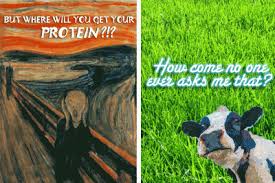
The reason why it is so outrageous that we are told to eat meat for our protein is that the human body builds its own human protein from the amino acids accessed from any quality uncooked source. All we need is amino acids... when we get them we don't have to consider the protein conversation any more. To say we need to eat animals to get protein is one of the most dangerous belief systems forced upon the masses possible. And if you want to produce human protein, why eat a cow when you can just eat a person and get the protein most similar to the one we will need to build. There sure is an abundance of dead humans, isn’t that what wars produce? Disgusting – dead Cows, Birds, Goats, Fish, Humans... all inferior ways for us to get our amino acid requirement.
Furthermore, look at the most common animals available for food in the market place and ask yourself what is their natural diet? Grass, grains, corn, soy - and they eat these foods and synthesize them into the protein needed to build the muscle (flesh) that some people then eat. So when you eat animal flesh it’s a second hand protein, because you have to break that meat back down into basic amino acids and then re-synthesize those amino acids back into a protein you can use. In the process of breaking down animal flesh all sorts of other nasty things are introduced into your bloodstream. So many in fact that in order to prevent viral and bacterial agents from entering the human bodies of those who consume meat, the FDA released an estimated 29 million lbs of antimicrobial drugs to be sold or distributed for use in food-producing animals, and this was in 2009 alone. Also, most commercial “food” animals consume large quantities of grain, grass, etc., which are to a greater or lesser extent contaminated with herbicides, pesticides, and other agents. These poisons concentrate in the fat of the animal and are present in highly concentrated amounts in an animal's milk and flesh.

Isn’t it ironic that the chief argument used to promote the use of animal products (that is, the purported need for large quantities of protein) is the greatest reason for avoiding them?
Did you know that the argument given by mainstream nutritionists that we should eat meat for attaining protein leads logically to the fact that the best meat for us to eat is human? I know this makes you squirm, but it is the case that if we are told that we need to eat protein that was already constructed for attaining our own...protein... why not just eat the protein that has been constructed perfectly already for what we will need... other humans!
The reason why it is so outrageous that we are told to eat meat for our protein is that the human body builds its own human protein from the amino acids accessed from any quality uncooked source. All we need is amino acids... when we get them we don't have to consider the protein conversation any more. To say we need to eat animals to get protein is one of the most dangerous belief systems forced upon the masses possible. And if you want to produce human protein, why eat a cow when you can just eat a person and get the protein most similar to the one we will need to build. There sure is an abundance of dead humans, isn’t that what wars produce? Disgusting – dead Cows, Birds, Goats, Fish, Humans... all inferior ways for us to get our amino acid requirement.
Furthermore, look at the most common animals available for food in the market place and ask yourself what is their natural diet? Grass, grains, corn, soy - and they eat these foods and synthesize them into the protein needed to build the muscle (flesh) that some people then eat. So when you eat animal flesh it’s a second hand protein, because you have to break that meat back down into basic amino acids and then re-synthesize those amino acids back into a protein you can use. In the process of breaking down animal flesh all sorts of other nasty things are introduced into your bloodstream. So many in fact that in order to prevent viral and bacterial agents from entering the human bodies of those who consume meat, the FDA released an estimated 29 million lbs of antimicrobial drugs to be sold or distributed for use in food-producing animals, and this was in 2009 alone. Also, most commercial “food” animals consume large quantities of grain, grass, etc., which are to a greater or lesser extent contaminated with herbicides, pesticides, and other agents. These poisons concentrate in the fat of the animal and are present in highly concentrated amounts in an animal's milk and flesh.
Isn’t it ironic that the chief argument used to promote the use of animal products (that is, the purported need for large quantities of protein) is the greatest reason for avoiding them?
Wednesday, September 5, 2012
Did you know? Our use of the word "fresh" does not apply to meat. (Video)
Did you know? Did you know it is kind of funny people like to advertise with the word 'fresh' to describe recently killed animals? Fresh is good to described fruits and vegetables... but fresh should not be used as an adjective for dead and microscopically rotting flesh...even if it was only recently killed. Otherwise roadkill would fall into that catagory.
2. Place animals in holding pens.
3. Knock them out by applying an electric shock of 300 volts and 2 amps to the back of the head, effectively stunning them, or by use of a captive bolt pistol to the front of the cow's head (a pneumatic or cartridge-fired captive bolt). Swine can be rendered unconscious by CO2/inert gas stunning. (This step is prohibited under strict application of Halal and Kashrut codes.)
4. Hang them upside down by both of their hind legs and place them on the processing line.
5. Sever the carotid artery and jugular vein with a knife. The blood drains from the body, causing death through exsanguination.
6. Remove the head and feet.
7. Cut around the digestive tract to prevent fecal contamination later in the process.
8. Remove the hide/skin by "down pullers", "side pullers" and "fisting" off the pelt (sheep and goats). Hides can also be removed by laying the carcase on a cradle and skinning with a knife.
9. Remove internal organs and inspect them for parasites and signs of disease. Separate the viscera from the heart and lungs, referred to as the "pluck" for inspection. Also separate livers for inspection. Drop or remove tongues from the head, and send the head down the line on head hooks or head racks for inspection of the lymph nodes for signs of systemic disease.
10. A government inspector inspects the carcase for safety. (This inspection is performed by the Food Safety Inspection Service in the U.S., and Canadian Food Inspection Agency in Canada.)
11. Reduce levels of bacteria using interventions such as steam, hot water, and organic acids.
12. Optionally Electrically stimulate cattle and sheep (only) to improve meat tenderness.
13. Chill carcases to prevent the growth of microorganisms and to reduce meat deterioration while the meat awaits distribution.
14. Cut the chilled carcase into primal cuts, subprimals and/or leave intact as a "side" of meat. Beef and horse carcases are always split in half and then quartered, pork is split into sides only and goat/veal/mutton and lamb is left whole.
15. The remaining carcase may be further processed to extract any residual traces of meat, usually termed advanced meat recovery or mechanically separated meat, for human or animal consumption.
16. Materials such as bone, lard or tallow, are sent to a rendering plant. Also, lard and tallow can be used for the production of biodiesel or heating oil.
17. The wastewater, consisting of blood and fecal matter, generated by the slaughtering process is sent to a waste water treatment plant.
18. The meat is transported to distribution centers that then distribute to retail markets.
Really! Does this sound 'fresh' to you?
Once you begin to see meat as it really is - a decomposing lump of flesh from a rotting corpse, it will be much easier to adapt a plant based diet. Not discounting the ethical and moral implications - because that's an entire different story.
 |
| Pretty discusting, huh? |
Furthermore, 'fresh meat' is slang for a high school or college freshman, or a girl who has yet to be sexually exploited - also pretty revolting.
Getting back to the deceptive use of the term 'fresh' in regards to meat; you may object, saying that fresh implies that the meat has not been frozen, dried or processed in any way. Even so, that is still a misnomer since meat comes from a dead animal and 'dead' and 'fresh' cannot logically coexist in the same description (can you say oxymoron?). Realisticaslly, the second an animal's heart stops beating it's flesh begins to decompose, oxygen present in the body is quickly depleted and without intervention, putrifaction and bloating occur, quickly followed by flies, gnats and then maggots.
The following is the typical procedure in the US for preparing livestock from a farm, to be delivered as 'fresh meat' to a store near you:
1. Animals arrive via truck or rail from a ranch, farm, or feedlot.2. Place animals in holding pens.
3. Knock them out by applying an electric shock of 300 volts and 2 amps to the back of the head, effectively stunning them, or by use of a captive bolt pistol to the front of the cow's head (a pneumatic or cartridge-fired captive bolt). Swine can be rendered unconscious by CO2/inert gas stunning. (This step is prohibited under strict application of Halal and Kashrut codes.)
4. Hang them upside down by both of their hind legs and place them on the processing line.
5. Sever the carotid artery and jugular vein with a knife. The blood drains from the body, causing death through exsanguination.
6. Remove the head and feet.
7. Cut around the digestive tract to prevent fecal contamination later in the process.
8. Remove the hide/skin by "down pullers", "side pullers" and "fisting" off the pelt (sheep and goats). Hides can also be removed by laying the carcase on a cradle and skinning with a knife.
9. Remove internal organs and inspect them for parasites and signs of disease. Separate the viscera from the heart and lungs, referred to as the "pluck" for inspection. Also separate livers for inspection. Drop or remove tongues from the head, and send the head down the line on head hooks or head racks for inspection of the lymph nodes for signs of systemic disease.
10. A government inspector inspects the carcase for safety. (This inspection is performed by the Food Safety Inspection Service in the U.S., and Canadian Food Inspection Agency in Canada.)
11. Reduce levels of bacteria using interventions such as steam, hot water, and organic acids.
12. Optionally Electrically stimulate cattle and sheep (only) to improve meat tenderness.
13. Chill carcases to prevent the growth of microorganisms and to reduce meat deterioration while the meat awaits distribution.
14. Cut the chilled carcase into primal cuts, subprimals and/or leave intact as a "side" of meat. Beef and horse carcases are always split in half and then quartered, pork is split into sides only and goat/veal/mutton and lamb is left whole.
15. The remaining carcase may be further processed to extract any residual traces of meat, usually termed advanced meat recovery or mechanically separated meat, for human or animal consumption.
16. Materials such as bone, lard or tallow, are sent to a rendering plant. Also, lard and tallow can be used for the production of biodiesel or heating oil.
17. The wastewater, consisting of blood and fecal matter, generated by the slaughtering process is sent to a waste water treatment plant.
18. The meat is transported to distribution centers that then distribute to retail markets.
Really! Does this sound 'fresh' to you?
 |
| Advertized as 'fresh' meat. |
Subscribe to:
Posts (Atom)